Hot gusty winds in Arizona at the end of June this year took a blaze out of control near Yarnell and overtook and killed 19 members of an elite fire fighting crew in the deadliest wildfire in the U.S. for over 30 years. It was yet another reminder that the demon fire can take over at any time anywhere. This tragic loss brought back some research memories of early fires and their consequences that I`d like to share.
Just over a hundred years ago U.S. Forest Ranger Ed Pulaski and 44 other men were forced to take refuge in the War Eagle Mine tunnel just outside of Wallace, Idaho. That was in the summer of 1910 when all across Montana, Idaho and Washington the forests were in flames. It had been a dry spring and dry lightning bolt storms in July had literally turned the Pacific Northwest into an inferno. Pulaski was in charge of a crew of firefighters that included miners and lumberman fighting alongside rangers. Using a pistol to forcibly keep those men in that mine tunnel in the midst of the Wallace blowup saved all but five of them. That August fire eventually claimed 85 lives, 78 of which were firefighters.
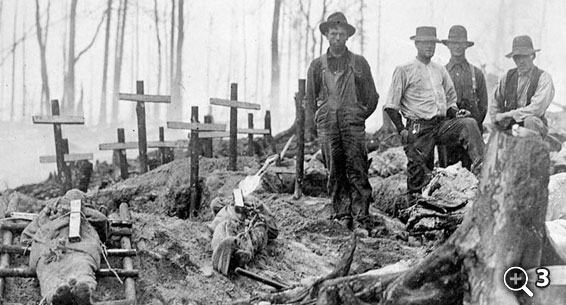
One year later on July 11th, 1911 the South Porcupine fire in Ontario recreated the same horrific scenario. Again two months of prolonged drought set the stage. On the 10th temperatures of 107 degrees Fahrenheit were recorded in the shade and smoldering brushfires were everywhere. The famous Porcupine fire that started that night formed a 20 mile wide horseshoe that rose 150 feet into the air and moved at eight miles an hour. The townspeople actually tried to stand against it with a bucket brigade but when the temperatures hit 118 everyone headed into Porcupine Lake alongside bears, moose and other wild animals trying to escape the fire. Many people were drowned in the lake while others suffocated to death. At one point a rail car loaded with dynamite exploded creating nine foot waves on the lake.
What a scene that must have been! By nightfall 500,000 acres (that's 781 square miles) had been destroyed and evaporation had lowered Porcupine Lake by two feet. The official loss of life was put at 73 but the woods were full of gold prospectors and it was probably more like 200.
Fires that reach this kind of intensity and power are referred to by firefighters as "blowups" or "firestorms". Not even the experts can predict for sure if one will develop but there are danger signals that are recognizable. Lots of dry and plentiful fuel-wood or grass, for instance- and strong, low level winds. I remember well how resistive the people of Canal Flats were a few years back to an evacuation order. Officials talked of firestorm potential then which the locals chose to ignore. It could very well have happened.
Just over 105 years ago what surely must be considered a firestorm swept through the town of Fernie, BC with unrelenting fury. One of the casualties of that unleashed demon was the first house ever constructed in what is now referred to in that community as the Ridgemont subdivision. The house, only 3 months old, had been built by Michael Mulligan who had just moved his family into it from Coal Creek. That fateful Saturday in August Michael's wife Elizabeth was outside with her four girls, Teresa, Anne, Roseanne and Nelly, supervising their Saturday bath. Elizabeth's only son Peter rushed onto the scene then and informed them that they should run for their lives from the fast advancing fire. The plaid quilts and blankets hanging on the clothesline and a bath privatizer were soaked down and wrapped around the girls who, dressed only in their petticoats, were rushed to the Great Northern rail line and the awaiting flatcars of an escape train heading for Hosmer. Incredibly, the blankets were bone dry on reaching the train, testimony to the intense heat of the fire. The fleeing family were also witness to that firestorm's convective power as they saw the roof of the Grand Theatre Opera House being ripped off and tossed across town.
I should add at this point that Elizabeth Mulligan was nine months pregnant with what would be her fifth daughter Margaret at the time. The Mulligan`s lost everything including Elizabeth's wedding rings which she had removed in the bathing process. Margaret Mulligan was born days later in a tent by the coke ovens down below Ridgemont.
Joe Gigliotti, a retired art teacher and nephew of Margaret's painted a depiction of his grandmother's recollection of what it looked like from the smoldering ruins of her new home the day after the fire. It now hangs in the stairwell of the beautifully restored Fernie Public Library. It shows Elizabeth and the four girls standing, still petticoated, on the crest of the knoll now known as Ridgemont Place, looking northwest. In the background are Fernie Mtn. and the Three Sisters (Trinity Mtn.) whose slopes are blackened by the previous day’s firestorm. The sky is painted red from the smoke and as you view the painting you find yourself wondering what thoughts were in Elizabeth's mind as she stood and viewed the utter devastation below her.
Whether it was Wallace, South Porcupine or Fernie there was always the potential back at the turn of the century for dry conditions and strong winds to unleash the demon fire. Given recent events here and abroad it appears that this threat is not about to go away ever.